
MODULE 2 — The King and His Church
(Revelation 2–3)
📘 MODULE 2 OVERVIEW
Module Title: The King and His Church
Scripture Focus: Revelation 2–3
Course: The Revelation of Jesus Christ – Kingdom Government
Level: Foundational / Diagnostic
Duration: 1–2 weeks (self-paced)
Module Description:
Before Jesus judges the world, He evaluates His Church. In this module, students study the seven letters to the churches and learn that Revelation is first corrective, not catastrophic. This module equips students to discern spiritual health, identify compromise, and understand what it means to be an “overcomer” in the Kingdom of God.
🎯 LEARNING OUTCOMES
By the end of this module, the student will be able to:
- Explain why Jesus addresses the Church before judging the world
- Identify the spiritual condition of each of the seven churches
- Apply the seven church diagnostics personally and corporately
- Define what it means to “overcome” in Revelation
- Teach Revelation 2–3 responsibly without condemnation or fear
📖 CORE TEACHING — MODULE 2 LESSON
1. Judgment Begins With God’s House
After revealing Himself as reigning King in Revelation 1, Jesus does not immediately speak about nations, Antichrist, or global judgment.
He speaks to the Church.
This establishes a Kingdom Government principle that governs the rest of Revelation:
God evaluates His own people before He judges the world.
Revelation is not first about what is wrong with society.
It is about what must be corrected among those who bear Christ’s name.
2. Jesus Walks Among the Lampstands
Jesus is seen walking among seven golden lampstands, which He identifies as the seven churches.
This reveals something deeply pastoral and deeply governmental:
- Jesus is present in His Church
- Jesus observes the Church directly
- Jesus evaluates the Church truthfully
Nothing is hidden:
- not faithfulness,
- not compromise,
- not tolerance,
- not neglect.
Revelation teaches that the Church is never ignored in God’s Kingdom order.
3. The Divine Pattern in Every Letter
Each of the seven letters follows a consistent structure, revealing Christ’s character as Judge and Shepherd:
- Revelation of Christ – Jesus reveals an aspect of Himself relevant to that church
- “I Know Your Works” – Full awareness, no ignorance
- Commendation – Faithfulness is acknowledged
- Correction – Sin and compromise are confronted
- Call to Repentance – Grace precedes judgment
- Promise to the Overcomer – Reward is offered
This pattern proves that:
- Jesus is fair
- Jesus is patient
- Jesus is truthful
- Jesus is redemptive
Correction is not rejection.
4. The Seven Church Conditions (Spiritual Diagnostics)
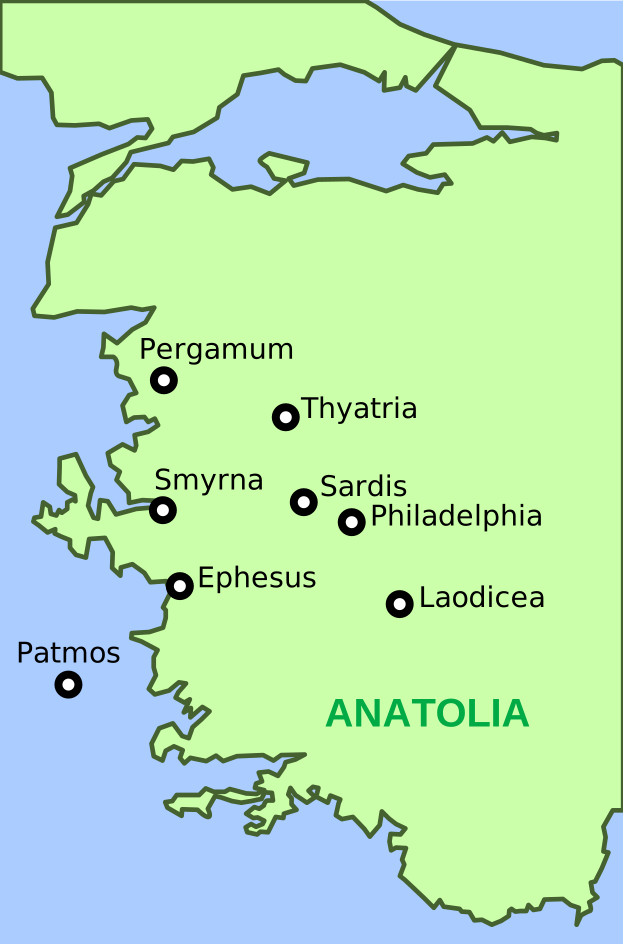
The seven churches represent real congregations and recurring spiritual conditions throughout Church history.
🔹 Ephesus — The Loveless Church
Strong doctrine, diligent service, but love for Christ has cooled.
Kingdom Lesson:
Right belief without love leads to spiritual emptiness.
🔹 Smyrna — The Persecuted Church
Faithful under suffering, poor in the world’s eyes, rich before God.
Kingdom Lesson:
Suffering is not failure; faithfulness under pressure is rewarded.
🔹 Pergamum — The Compromising Church
Holding truth while tolerating compromise.
Kingdom Lesson:
Truth loses authority when compromise is allowed.
🔹 Thyatira — The Corrupted Church
Love and service present, but moral corruption tolerated.
Kingdom Lesson:
Good works never justify unchecked sin.
🔹 Sardis — The Dead Church
Strong reputation, no spiritual life.
Kingdom Lesson:
Reputation before people means nothing without life before God.
🔹 Philadelphia — The Faithful Church
Small strength, great obedience.
Kingdom Lesson:
Faithfulness opens doors that power cannot.
🔹 Laodicea — The Lukewarm Church
Comfortable, self-sufficient, spiritually blind.
Kingdom Lesson:
Comfort is one of the greatest threats to spiritual urgency.
5. “He Who Has an Ear, Let Him Hear”
After every letter, Jesus repeats the same warning.
This reveals that:
- These letters are not optional
- They are not historical only
- They are meant to be heard now
The Spirit still speaks through these warnings to the modern Church.
6. The Overcomer Principle
Each letter ends with a promise to “the one who overcomes.”
This introduces a major Kingdom truth:
Salvation is free, but reigning is conditional upon faithfulness.
Revelation distinguishes between:
- being saved, and
- overcoming faithfully.
Rewards are promised to those who endure, repent, and remain loyal to Christ.
7. Why Revelation Places This Here
Before:
- seals are opened,
- trumpets are sounded,
- bowls are poured out,
Jesus ensures His Church understands:
- love,
- holiness,
- faithfulness,
- repentance,
- endurance.
Revelation is not written to satisfy curiosity — it is written to prepare a faithful people.
“He who has an ear, let him hear…”
📝 STUDENT NOTES
- Jesus evaluates His Church first
- Faithfulness matters more than reputation
- Repentance is always offered
- Overcoming brings reward
- Comfort can be dangerous
💬 DISCUSSION QUESTIONS
- Why does Jesus address the Church before the world?
- Which church condition is most common today, and why?
- How can believers avoid becoming lukewarm?
✍️ ASSIGNMENT (REQUIRED)
Diagnostic Reflection (600–800 words):
Identify which of the seven church conditions most closely reflects your personal walk with Christ.
Explain why, and describe one step of repentance or strengthening.